 Sparklets
Articlereal estate6 min read
Fifteen agents, forty listings, one owner's week
A worked example, not a member's story: how the owner of a residential brokerage with fifteen agents and a dozen rentals under management would run a week through a personal assistant that makes the calls, keeps the calendar honest and watches the money.
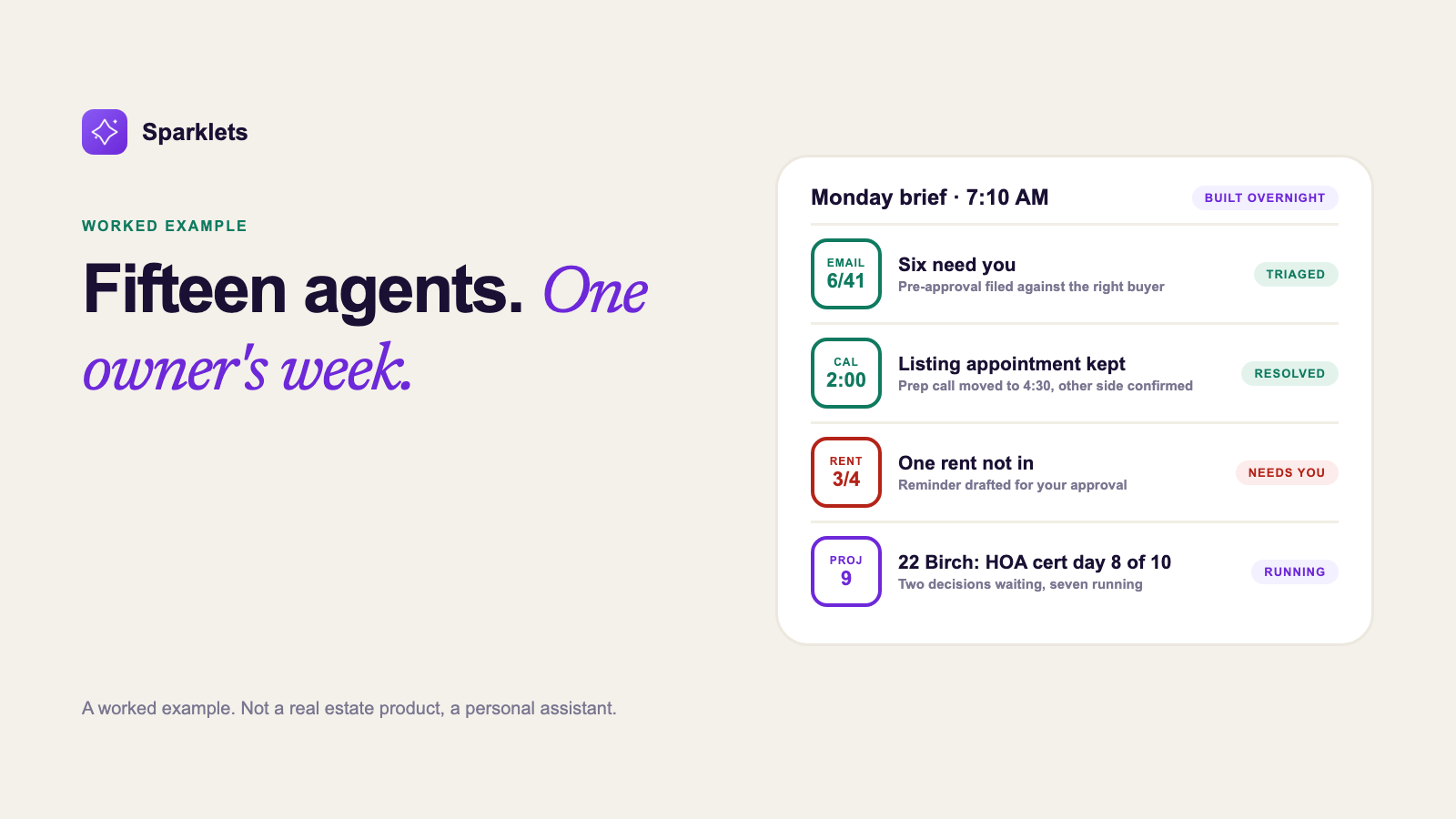
This is a worked example, not a member's story. We wrote it because the question comes up often: Sparklets is a personal assistant, not a real estate product, so what would it actually do for someone who runs a brokerage? Here is one week, for an owner we will call Priya: fifteen agents, about forty active listings, twelve rentals under management, two showings a day somewhere in the office, and a phone that never stops.
Monday, 7:10 AM: the brief
Priya reads one page before the office opens. Her assistant built it overnight from her inbox, her calendar, her open projects and her accounts.
- Forty-one emails came in. Six need her. The rest were agents copying her on things that are moving fine, two vendor newsletters, and a lender confirming a pre-approval, which it has already filed against the right buyer.
- The calendar had a conflict at 2:00, a listing appointment on top of the Tuesday prep call. It moved the prep call to 4:30 after checking with the other side, and says so.
- Money: three rents cleared over the weekend. One did not. The photographer's invoice is due Thursday. The earnest-money deposit for 14 Maple is still showing as pending at the title company, which it will chase today.
- Open projects, one line each, with what it needs from her. Two of the nine need a decision. The rest are running.
That page is the point of the whole thing. It is not a summary of her tools. It is a summary of her week, written by something that has been carrying the week with her.
The projects that run for weeks
Most of what eats a brokerage owner's time is not a task. It is a project with a dozen small parts and a deadline, and nobody but the owner holding all of it in their head.
"Get 22 Birch ready to list by the 15th." Priya said that once, two weeks ago. Since then the assistant has called three stagers and got quotes, booked the cleaner, coordinated access with the current tenant around her shifts, chased the HOA for the resale certificate (ten business days, it turns out, and it is day eight), and scheduled the photographer for the morning after staging. It came back to Priya twice: once to pick stager A or B, once to approve an extra day because the HOA was slow. Everything else it decided inside the lines she gave it at the start.
Each project like this has its own thread and its own memory. When she talks to it about Birch, it knows Birch. When she opens the one about renewing the office's errors-and-omissions policy, it knows that one: three quotes requested from the uploaded policy, two in, one agent still "checking with underwriting." The twelve lease renewals are a third, with a calendar of their own.
The phone
The brokerage phone is where owners lose whole afternoons, and it is where the assistant earns its keep.
Outbound, it does what it has always done for our members: it calls the county clerk and waits on hold so Priya does not have to, it calls the inspector to move a slot, it calls the title company about the deposit. When the bank will only speak to the account holder, it conferences her in for the thirty seconds that only she can do, then carries on.
Inbound is where it gets interesting. When the inspector calls back, the assistant knows who he is, because it called him first, and takes the time he offers rather than making him leave a voicemail. When a tenant calls about a leak at one of the rentals, it logs it, texts Priya, and, because she approved a short list of vendors up front, calls the plumber. When one of her own agents texts "is the Maple deposit in?", it answers from the ledger and tells her it did.
It handles her people differently from strangers. Her agents, her lender contacts and her regular vendors are in her circle. It knows what it may share with each of them and what it may not. A number it does not know gets a polite assistant who takes a message and promises nothing.
Tuesday: the sales meeting, and the listing appointment
The weekly sales meeting runs forty minutes. With everyone's consent it records, and by the time Priya is back at her desk there are notes, and under the notes a list: who promised what, by when. The follow-ups are on the calendar. Mark, who is out Fridays, has his moved to Thursday without anyone asking.
Before the 2:00 listing appointment it hands her a brief: the property, recent comparable sales, what the sellers said in their first email three weeks ago, and the fact that they mentioned a relocation deadline. She walks in prepared, which is the whole job.
What it remembers
The Hendersons prefer texts, and not after 6 PM. The Maple HOA takes ten days for anything. The cleaner wants forty-eight hours' notice. The lender at the credit union answers email faster than the phone. None of this was entered into a system. It was learned the way an experienced assistant learns it, and it is there the next time.
Money, watched rather than moved
Priya's accounts, the rent receipts, the vendor bills and the brokerage's running costs sit in one place, and the assistant watches them until each payment actually clears, not until it is scheduled. The rent that did not arrive is a line on Monday's brief, with the tenant's name, and a draft of the reminder she would normally write at 10 PM. She approves it and it goes. The assistant never moves money itself. When something is to be paid, she pays it, on her own card or from her own account, in a session she can watch.
What she switched on, and what she did not
This is the part owners ask about first. Priya gave the assistant her work email and calendar, the brokerage phone line, texts, her contacts, and the memory of her clients. She did not give it her personal email. She turned the live view on for anything it does in a browser, so she can watch a form being filled and take over mid-task if she wants to. Every one of those is a switch she can flip the other way tonight.
Friday afternoon
The assistant drafts the week's "just listed" post for her LinkedIn page, with the photos from the Birch shoot. She reads it on her phone, changes one word, and it posts. The new inspector and the credit union lender are in her contact book with notes. The Birch project moves to "listed." Nine projects become eight.
What it is not
It is not an MLS, a CRM or a transaction-management system, and it does not replace an agent or a transaction coordinator. The signatures, the disclosures and the trust accounting stay with the people licensed to handle them. What it takes is the layer underneath: the calls, the waiting, the chasing, the remembering, and the page every morning that says what the week needs from her.
When something in the app is unclear, Sparky answers it in the app. When Priya would rather talk to someone, Amy picks up the phone.
Questions
Is Sparklets a real estate product?
No. It is a personal assistant that happens to be good at the work a brokerage owner carries: calls, follow-ups, calendar, contacts, money. This post is a worked example of how one would use it.
Does it work with my MLS or CRM?
It works through email, phone, text, a secure browser, your calendar and your contacts. If your MLS or CRM is on the web, it can work in it the way you would, with you watching. There is no special integration.
Do my agents each need an account?
Each person has their own assistant. Yours coordinates with your agents as people, by email, text and phone, the way you would.
Does it see client financial information?
Only what you give it, and only for the work you asked for. Every source is a switch you control. We never sell your data or share it with data brokers.