 Sparklets
Articlemoney3 min read
The late fee you did not pay
Most late fees are for bills you thought were handled. Money watches each one until the payment actually clears, and speaks up only when it does not.
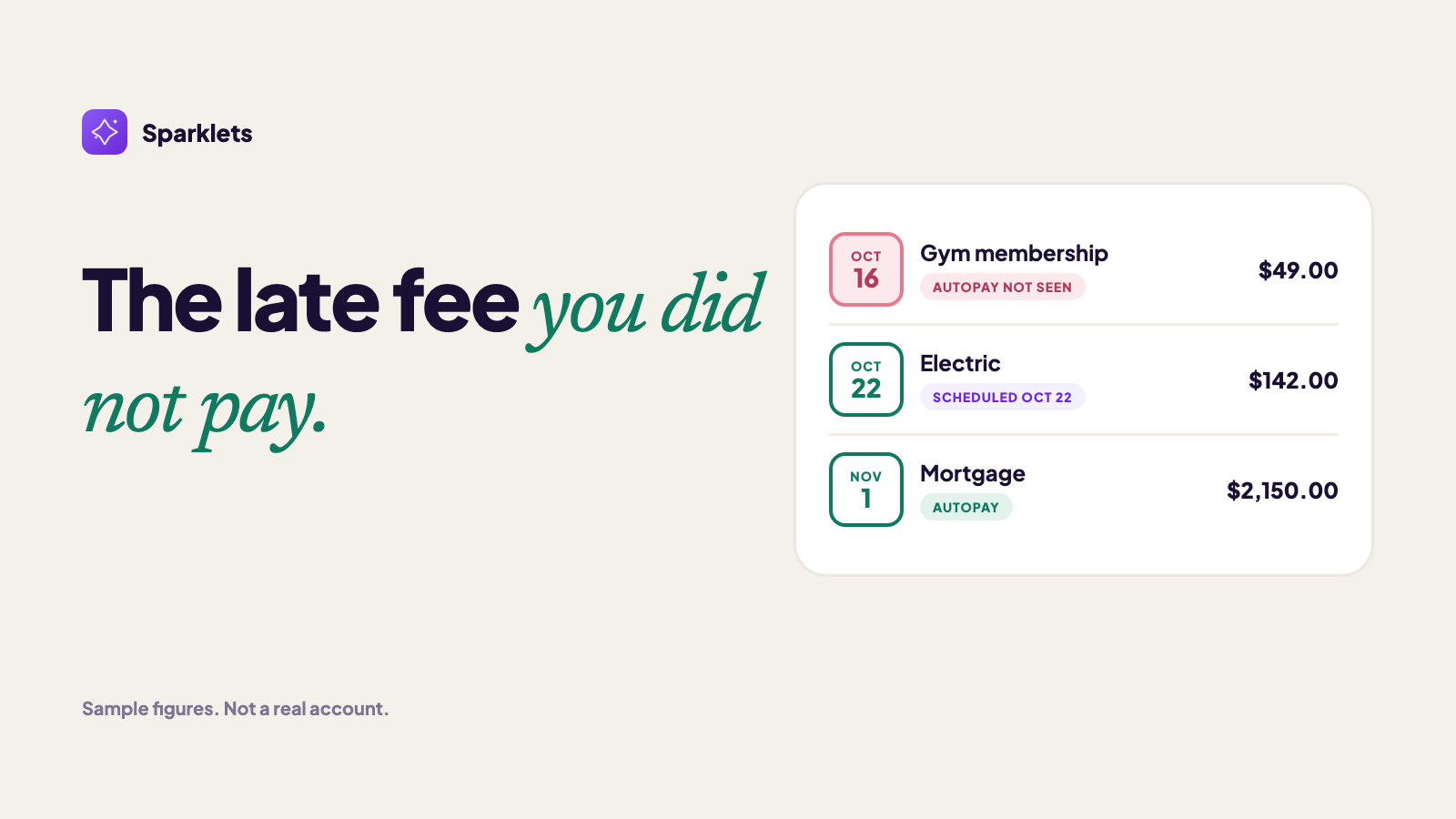
Most late fees are not about money. The money was there. The bill was "handled" in someone's head: the autopay was set up two years ago, the card on file was the old one, and nobody checks that a payment actually landed until a letter arrives. We have all paid a fee for a bill we thought was done.
When we started building the Money side of Sparklets, we assumed the hard part was budgets. It was not. The hard part was this gap between "I took care of it" and "the money actually left my account," and almost nothing in the usual apps lives in that gap. They list bills. They remind you. Then they stop.
What a bill is, to us
A bill is not a date. It is a small promise with four states: coming up, scheduled or on autopay, actually paid, and the quiet fourth one, supposed to be paid but not seen. Our job turned out to be watching for that fourth state.
So Money reads your own bank and card accounts and finds the recurring bills in your history: the mortgage, the electric, the gym, the streaming service you forgot. You confirm them, or dismiss the wrong guesses, and from then on each one is tracked.
Watching until it clears
Here is the part that matters. When a bill is on autopay, or you mark it scheduled, Money does not tick it off. It waits for the payment to show on the account it is supposed to come from. On the day it shows, the bill moves to Paid. If the day passes and nothing shows, it moves to Needs attention, and that is the one moment you hear from us.
A real example, with the names changed. A member's gym membership was on autopay to a card that had quietly expired in September. Nothing told her. In October the gym tried the card, failed, and said nothing either. On the 16th, the day the payment was expected and did not appear, Money raised one alert: gym autopay not seen, card may have expired. She fixed the card that evening. Without the alert, the next thing she would have heard was a lapsed membership and a reinstatement fee in November.
Why the alerts stay quiet
We made a rule early: an alert has to be about something that did not happen when it should have, or a number that moved past a line you set. A bill due in three days is not an alert. A bill that was due yesterday and never cleared is. A budget at 80 percent is not an alert. A budget that passed its pace with a week left is. The result is a panel that is usually empty, which is the point. When it is not empty, you look.
Where it is still imperfect
Suggestions are guesses from your history, and they are sometimes wrong: a one-time purchase that looked recurring, a subscription that changed its name. Dismissing takes a tap, but it is still a tap you did not ask for. Bills paid by cheque are invisible to us until the cheque clears, which can be slow. And a card issuer that moves a due date without telling anyone can make a scheduled payment look late for a day. We would rather say these out loud than let you find them.
The quiet connection to the rest of Sparklets
Money is a membership on its own, $10 a month, and it does not include the assistant. But for members who have the assistant, the alert is not the end of the story. "Fix it" is a sentence the assistant can act on: it opens the gym's billing page, updates the card, retries the payment, and keeps watching until it clears. That is the shape we are working toward across all of Sparklets: find the thing that slipped, and then do something about it, with you deciding.
If you have a bill story of your own, the kind that cost you a fee you did not deserve, write to hello@sparklets.ai. It is how most of this got built.