 Sparklets
Articledelegations4 min read
The things that slip when work wins
Why personal admin loses to work, and what changed when we made the unit of work a whole project instead of a task.
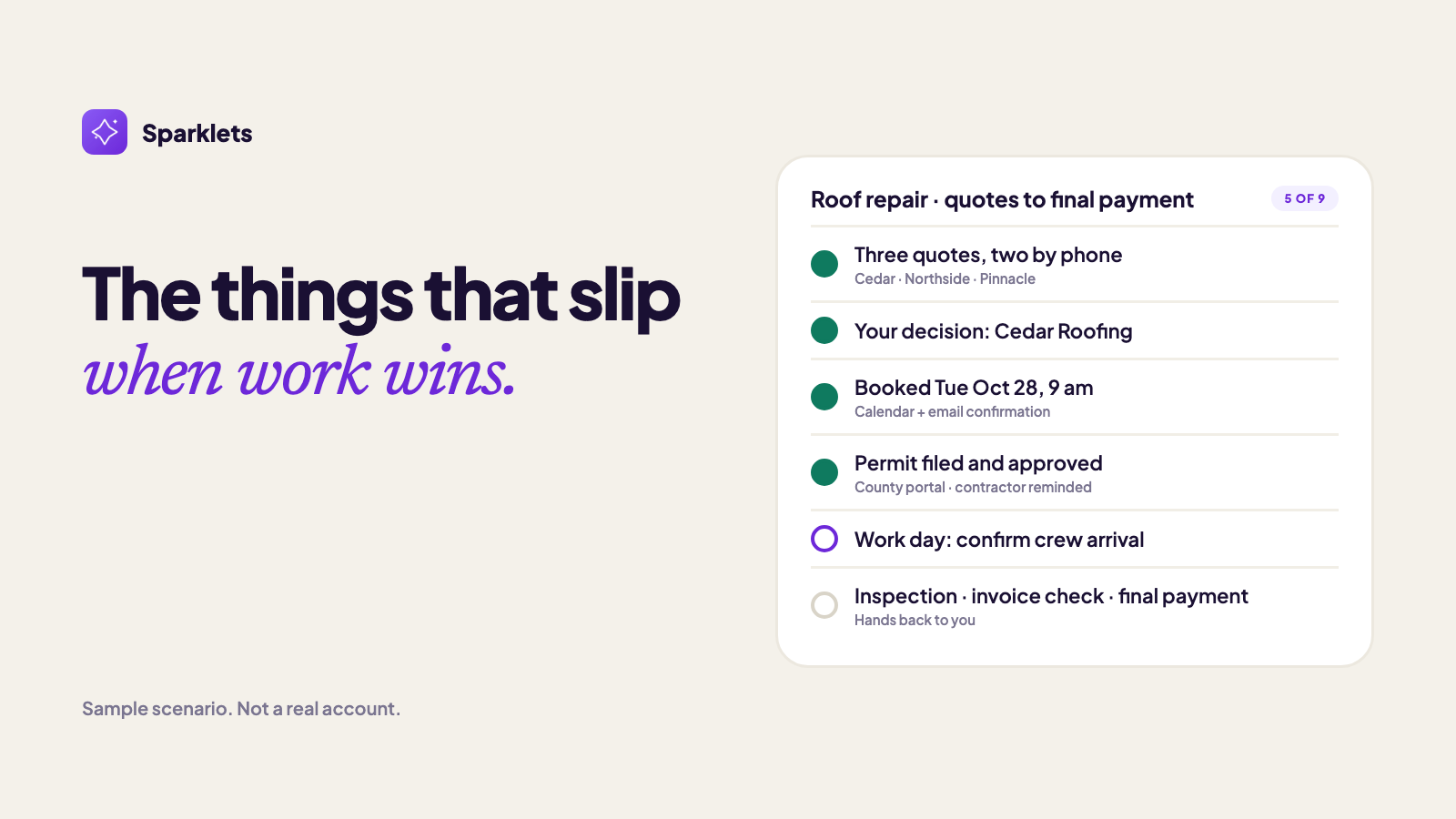
Most of us do not decide to put work first. It just happens. Work has a calendar, a manager, a deadline, and people who notice when something is late. The rest of life has none of that. So the dentist appointment that needed rebooking slides a month. The contractor who gave a quote in August never gets a call back. The school form sits open in a browser tab until the deadline passes. The subscription you meant to cancel renews again.
Nobody is proud of this. Most of us are a little ashamed of it, which is why we rarely talk about it. Work is loud and family admin is quiet, and the quiet thing loses.
We are a small team building a personal assistant for exactly that quiet side of life. We are not going to claim it solves the problem. We want to describe what we have learned trying, because some of it surprised us.
A to-do list is not the problem
Everyone we talked to already had a list. Several lists. The items on them were not hard. "Call the roofer." "Sort out the insurance claim." "Find a Saturday that works for both families." The difficulty was never knowing what to do. It was that each item is actually one step in something much longer, with waiting in between, and every time you come back to it you have to rebuild the context from scratch. That rebuilding cost is what makes people put it off again.
So the first thing we changed was the unit of work. You do not give the assistant a task. You give it the project and let it carry the steps and the waiting, for as long as the project lasts.
A roof is a good example, because choosing the contractor is the easy part. The assistant gets the quotes, calls the two roofers who did not reply, and brings you the choice. Then it keeps going: confirms the start date, chases the permit, reminds the contractor the week before, asks for the inspection, checks the invoice against the quote, and tells you when the final payment is due. Weeks later, when the gutter guy needs to know what was done, the context is still there.
The same shape fits most of the things that slip. A kitchen remodel with five trades who all need the same dates. A child's school year, with the forms, the fees, the pickups and the teacher emails. A college application season, with deadlines across eight schools and the recommendation letters that have to be asked for twice. Buying a house, with the lender, the inspector, the insurer and the lawyer all waiting on each other. If it can be moved along with email, a phone call and a web form, the assistant can carry it, and come back to you only for the decisions that are yours.
People want to stay in charge
We assumed people would want everything done for them. They did not. Almost everyone wanted to see the work and keep the decisions. So the assistant shows what it is doing as it does it, and you can stop it, take over a call or a form yourself, and hand it back. The decisions that are yours stay yours. We think this is right, and we also think we would have built it wrong without being told.
The money slips the same way
Household finances follow the same pattern. Not the big decisions, the small maintenance: the bill that was "handled" in your head but never cleared, the autopay that silently failed, the budget that drifted. We added a Money side for this, read from your own banks, that tracks a bill until the payment actually shows and only speaks up when something did not happen that should have. It is $10 a month on its own and does not include the assistant, because plenty of people want only that.
What we charge for, and why
We decided early that we would not run ads and would not sell data. We charge a membership instead. It is a less comfortable business to build, and it means we are not free. But it means the assistant works for you and nobody else. If it ever suggests a card or a loan, it will be because you asked.
Where we are
Sparklets is small on purpose. The assistant starts at $30 a month on a pay-as-you-go basis, and we still get things wrong: a call that should have been an email, a question that came back to you too early. We fix those as members tell us about them, and we would rather hear that than anything else.
If some of this sounds like your own list, the plans are at sparklets.ai. If you only want to tell us what keeps slipping for you, write to hello@sparklets.ai. We read every one.
Bank connections are read-only, provided through Plaid.