 Sparklets
Use caseinsurance2 min read
Three insurance quotes from one uploaded document
For years a member let his insurance roll over because re-quoting meant digging out policy limits and repeating them to three agents. This time he uploaded one document, and the assistant did the rest.
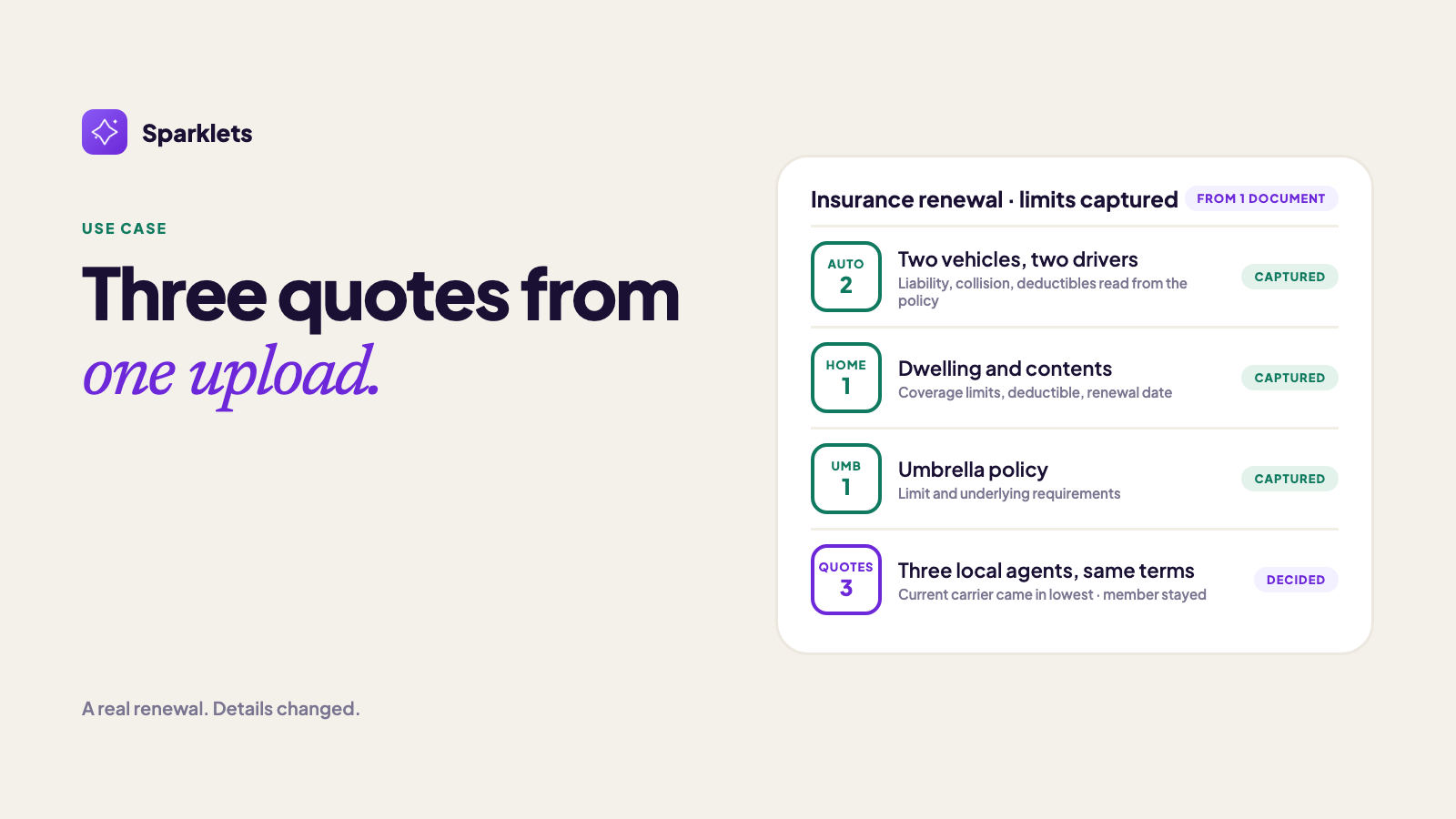
Every year, at renewal, a member in the New York area did what most people do: nothing. Not because he thought his carrier was cheapest, but because finding out meant digging the current limits and deductibles out of three policies, then either calling each agent to read them out or filling the same long form three times. Against a full week, the renewal always won. The policy rolled over, year after year, unexamined.
This year he did one thing differently. He uploaded his current policy documents, auto, home and umbrella together, and asked his assistant to get him quotes.
What the assistant did
It read the documents and pulled out what an agent needs to quote: vehicles and drivers, the home's details, every coverage limit, every deductible, the umbrella amount, and the renewal date. The part that had stopped him for years took no time of his at all. It then contacted three local independent agents, gave each the same details, and asked for a like-for-like quote on the bundle. No forms. No reading limits down the phone.
When the quotes came back it put them next to the current policy, line by line, so the comparison was honest: same limits, same deductibles, and where an agent had quoted something different, it said so.
The result surprised the member. His current carrier was the cheapest of the three. He decided to stay, which is a decision that is worth more when you know what the alternatives cost. The whole exercise took him about twenty minutes of attention, most of it reading the comparison.
The moment the carrier wanted him
One part needed the member in person. When the assistant called his current carrier to confirm the renewal terms, the carrier would only discuss the policy with the policyholder. That is the right rule, and we would not want it any other way.
So the assistant conferenced him in. He joined the call, confirmed who he was, answered the carrier's questions, and dropped off. The assistant stayed on, finished the conversation, and recorded the outcome. This is how it is supposed to work: the assistant does the waiting and the paperwork, and brings the member in for the thirty seconds that only he can do.
What changed for the member
- The step that had blocked him for years, capturing the current limits, became one upload.
- No forms filled, no details read out three times.
- Three real quotes on the same terms, not three brochures.
- A renewal he chose on evidence, for the first time, instead of one that rolled over.
- One short call instead of a week of them.
Questions
Does the assistant see the policy documents?
Only the ones the member uploads for the job, and only to pull the details an agent needs. Nothing is shared beyond the agents the member asked it to contact.
What if the carrier will not talk to the assistant?
It brings the member into the call, then carries on. Carriers and banks often insist on the account holder, and the assistant is built for that handoff.
Why not use an online comparison site?
Those quote the simple cases. A bundle with an umbrella policy usually needs an agent, and the assistant can work with agents the way the member would.